Science
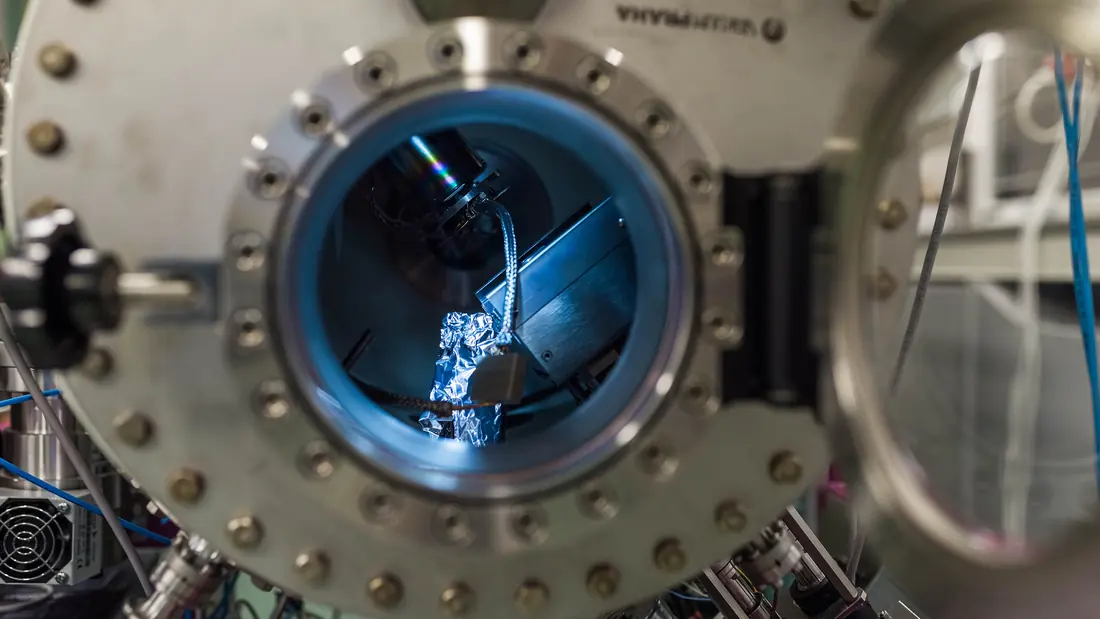
A new superinductor created within a silicon integrated circuit
A recent study published in Nature Electronics and carried out by researchers from nanoGUNE's Quantum Hardware research group, Quantum Motion, London Center for Nanotechnology, Imperial College London and the University of…
- Published
- (50 min ago)
- Outlet
- Phys.org
- Section
- Science
- Length here
- Headline and 31-word snippet. The full article is at the source.
More from Phys.org and around the same time
 A carefully timed pair of light pulses can amplify the motion of atomic layers in a quantum materialThe principle "Work smarter, not harder!" apparently also applies to controlling quantum materials with light. Many of their fascinating properties depend on how the atoms are arranged in the crystal. Ultrashort laser pulses can…NASA navigation experiment shows promise for planetary landingsNASA has successfully demonstrated technology designed to help spacecraft autonomously navigate to safe landing sites on the moon and on other planets. An Alta-X drone equipped with the agency's Safe and Precise…Flat feet may have helped Neanderthals stay stable while carrying heavy loadsIn all likelihood, the Neanderthals had flat feet. But it was not a defect at all. Instead, it was the consequence of a precise functional strategy to reduce impact stress under heavy loads and maximize stability on mountainous…Hundreds of Ice Age rock art engravings discovered hidden in plain sightArchaeologists have discovered the third-largest assemblage of Ice Age cave art ever found in Mediterranean Iberia in a region thought devoid of cave art, transforming our knowledge of Paleolithic European art.Trust in influencers grows more important in predicting buying intentions over time, analysis findsA meta-analysis of empirical studies involving more than 31,000 participants has revealed the factors that affect the level of influence of so-called social media influencers. Those factors include credibility, expertise…Carbon dots fluoresce their way through the rainbow as liquids changeFluorescent materials usually emit a single consistent color. They are typically made from dyes or metallic components. In contrast, researchers reporting in ACS Central Science have created carbon dots that can fluoresce in a…
This page holds the headline and a short snippet as published by Phys.org, whose feed they came from. The story itself, the photography and the rights stay with them, and the button above goes straight to their site. We keep this page so the headline has a stable address and a record of when it ran.